


Heaps of sand are used in construction, engineering, and geotechnical activities, and it is no secret that sand comes along with other complex materials whose performance and behavior greatly depend on it. Among these props, bulk density and relative density play various roles. This paper examines the distinct features and practical applications of these props, providing definitions and methods of measurement. The paper, however, is beneficial to both beginners in this field and anyone interested in sand, as it can help them understand the real-world applications of sand.
Definition and Importance of Sand Density

Sand density represents the weight of sand material enclosed in a volume. It is usually expressed in terms of mass per unit volume – for example, the kilogram per cubic meter or the gram per cubic centimeter. This is a crucial measure for sand in any given area. It is essential in applications including construction, engineering, and geotechnical projects. Sand density is the key to accurately estimating the load-bearing capacity, stability, and material usage in a project. Especially in practical projects, it is indispensable to know the density of sand beforehand to design foundations, protect structural systems, and ensure the effective use of resources according to the set conditions.
What is Density of Sand?
The mass of sand required to occupy a specific volume is usually specified in units of grams per cubic centimeter (g/cm³) or kilograms per cubic meter (kg/m³). It is obvious sand will have variant densities based on its particle size, moisture content, and the degree of compaction.
Key Density Values:
- Dry sand: 1.4 to 1.65 g/cm³ (1400 to 1650 kg/m³)
- Wet sand: approximately 2.0 g/cm³ (2000 kg/m³)
Heavily compacted sands tend to have higher density, as sand is loose and hasn’t been compacted. Alternatively, lightly compacted sand, where grains are closely packed, tends to have higher density, with no voids created, meaning closely packed molecules are included.
Importance of Sand Density in Various Industries
Construction Industry
The ideal use of sand is in the foundation structure, can be used to mitigate settlement difficulties.
Geotechnical Engineering
Consolidating and churning mixers can analyze and predict the density in the sand to evaluate the soil strength and deformation properties.
Applications of Bulk Density in Construction and Engineering
- 1
Determination of Concrete Mixtures: Bulk Density is specifically used in determining the amount of cement, aggregate, and water required in concrete to achieve the highest possible strength and durability. - 2
Base and Subbase Compaction: Bulk Density is used in the compaction of aggregates and soil used in road construction to prevent settlements and maintain the integrity of the road. - 3
Soil Stability Analysis: Bulk Density is used in load extraction and in the measurement of the slope in land engineering in the assessment of load extraction measurements. - 4
Material Transport: For construction materials, determining the load of sand in dumpers and trucks from production to delivery can be done, thus offering a lower load limit. - 5
Design of Hydraulic Fracturing and Filtration Devices: In the optimization of sintering filters, the sintering filters can usefully maintain oil fracture and are used to assist with accurate but lower sintering filtration glass.
Types of Sand and Their Density Characteristics

Natural vs Manufactured Sand
Specific Gravity of Different Sand Types
The term ‘specific gravity’ with respect to sand refers to the density of sand in comparison to water, under standard conditions. It is a decisive factor in the building industry and is useful in measuring the quality of the sand particles for building and construction purposes.
Natural Sand
2.65 – 2.67
Construction-grade sand is primarily natural, with silica as its central component.
Manufactured Sand (M-Sand)
2.56 – 2.64
Controlled impurities on the particle size and rock particles.
River Sand
2.65 – 2.70
Sand with traces of quartz with slight uniformity.
Note: The specific gravity values are crucial for computing the mixture of concrete, and for verifying the structural integrity and performance of the final product due to the improved precision of its components.
Factors Influencing the Density of Sand

Distribution of Grains
The percentage of particles in the sand affects the density. A sand that is evenly spread tends to build better voids when minerals of different shapes are used, leading to a higher “building” density.
Moisture Content
Sand with appropriate moisture has an optimal compaction, which helps fill the voids. However, excessive humidity has the opposite effect, with too much water content.
Shape of Particles
The shape of the particles has a direct impact on the density. Angular grains tend to have greater density since they lie closer together, while rounded grains create space.
Compaction Method
The manner in which the sand is compacted and the force that is exerted on the particles affects the particle arrangement of the sand to reduce voids.
Foreign Matter
The presence of impurities, such as clay or silt, can significantly reduce the efficiency with which sand is compacted and affect the total mass in comparison to the total volume.
Moisture Content and Its Effect on Density
Water has a significant effect on particle adhesion in sand. With very little of it in the sand, some capillary force develops, enhancing mechanical binding and improving adhesion with sand particles. The so-called “optimum moisture content” factor determines the moisture point at which sand has its highest dry density and the least air voids.
Key Point: Beyond the optimum point, saturated waters start to occupy the particles’ interstitial cavities, leading to a drop in sand’s density. In engineering applications, the excess films buildup hinders weak particle reorganization and debilitates the sand by decreasing the assemblage’s strength.
Methods for Measuring Sand Density
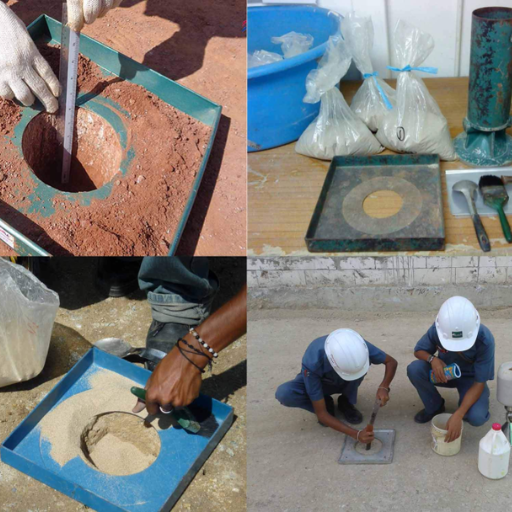
Advanced Technologies in Measuring Sand Density
New technologies have made it possible to come up with better solutions of measuring densities. There are at least two notable methods, one of which includes the nuclear density gauge. It functions in that with radioactive material it can have a great close through, hence a high ability of penetration; as a result, it can measure great depths. No matter where in the world a particular thing, such as sand, can be found, the test does not require samples to be sent for testing; on the contrary, it can be observed on location. Such a method is quick and efficient; as a solution to a test problem, it provides an estimate of sand density in under three hours of work.
Ground Penetrating Radar (GPR)
A second application of technology is in the world of radar, and its advancement in the electromagnetic spectrum has undoubtedly brought about new ways to read the ground. Often in road construction, it is necessary to know what the layers are composed of.
Machine Learning Systems
The most important advancement is the imaging aspect of innovative technology. The automated systems are almost infinitely desirable when considering the issue of sand density. Using cameras, the project uses algorithms provided with machine learning to predict densities. Improvements have reduced the error by 1.5 percent margins.
Practical Applications and Challenges

✅ Applications
- Construction projects
- Road building
- Geotechnical Engineering
- Load-bearing capacity calculations
- Material optimization
⚠️ Challenges
- High equipment costs
- Training requirements
- Environmental constraints
- Integration complexities
- Safety considerations
Common Challenges in Sand Density Measurements
Moisture Content Variability
Uneven moisture levels within the sand can inaccurately report the material’s density.
Calibration Errors
Nuclear density gauges demand proper and frequent calibration to produce reliable results.
Operator Expertise
The precision of sand density measurement often hinges on the proficiency of the operator.
Environmental Conditions
Temperature, wind, and pressure variations can lead to measurement inaccuracies.
Frequently Asked Questions (FAQs)
Reference Sources
- Technology.org – What Is The Relative Density of Sand, And How Is It Measured?
This source explains the concept of relative density, its measurement, and its dependence on sand packing. - UDTECH – Density of Sand and Rocks
This article provides insights into the bulk density of sandy soils and compares it with other soil types. - Housing.com – Density Of Sand In Kg/m3: All You Need to Know
A detailed guide on measuring sand density, including values for loose, dry, and packed sand.
Key Takeaways
Understanding sand density is crucial for successful construction and engineering projects. From proper material selection to accurate load-bearing calculations, density measurements ensure structural integrity and resource optimization. With advancing technology, measurement methods continue to improve, offering better precision and efficiency for modern construction needs.


