


One of the most widely used igneous rocks is granite, whose versatility and appeal primarily derive from its distinctive physical properties, most notably its density. Understanding granite density is not merely a geological parameter; it is a key factor affecting its strength and durability, with applications in design, construction, and other industries. In this article, the characteristics and relevance of granite density will be comprehensively explored to deepen understanding of this subject. This blog post will introduce you to the remarkable properties of granite’s density, whether you are a geology enthusiast, a geologist, or simply an inquisitive person interested in how these rocks form our Earth. Let us explore the nature of these stones and reveal both their superficial beauty and the functional abilities of this natural wonder!
Introduction to Granite

Granite is an intrusive igneous rock that crystallizes from molten magma deep within the Earth’s crust. It is coarse-grained and highly resistant to chemical weathering due to its quartz, feldspar, and mica mineral content. Owing to its durability, granite is often used in constructions, benchtops and monuments. Its appeal and multiple functions enable this.
What is Granite?
Granite is a deep-seated igneous rock. The rock is usually gray and consists of three minerals—quartz, feldspar, and mica. Since these minerals have a large particle size, the rock is essentially rough and exists in diverse natural colors such as white, pink, grey or black. This rock is commonly used in the construction industry and in residential homes, particularly in kitchens, bathrooms, and floors, for its high density, which makes it resistant to scratches, heat, and weathering. Moreover, granite exhibits distinct colors and patterns in each solid piece due to its formation; therefore, it is highly valued for its beauty. It is considered one of the strongest readily available materials; consequently, it has long been helpful for a wide range of applications.
Formation and Origin of Granite
The formation of granite involves the slow crystallization of magma in the Earth’s lithosphere. Intrusive igneous rock deposits such as granite are formed of silica-rich minerals and feldspar, which give granite its peculiar appearance and strength. Such a rock has been formed through cooling processes over millions of years, often in geologically complex areas. The density of granite is significantly affected by lithospheric dynamics, particularly at continental plate boundaries and in regions of plate convergence. These geological factors, along with their structural chemistry, enable the formation of granite in various textures and colors, which has contributed to its popularity as a creative and expensive material.
Types of Granite: Black, Grey, and Red Granite
Black Granite
Black granite, mainly used for decoration because of its visual appearance, has a high concentration of minerals such as pyroxene and feldspar which confer the rock its black color. This granite is used mainly in making countertops, floors and even monuments, particularly because it is strong and can be provided in a polished form. Some of the most well-known varieties include Absolute Black granite and Black Galaxy granite.
Grey Granite
Aesthetically, grey granite has a neutral, flexible appearance because it can combine grains of quartz, feldspar, and mica. It features patterns that are either soft or very bold, making it suitable for both outdoor and indoor installations, such as tiles, paving blocks, or statues. For instance, Silver Cloud and Steel Grey are ubiquitous.
Red Granite
Red granite comes in bold colors which can be attributed to the high content of potassium feldspar in its formation process. Its durability qualities are suitable for countertops, sculptures or ornamental purposes. Some examples include Rosso Multicolor granite and Indian Red granite.
Physical and Chemical Properties of Granite

Mineral Composition of Granite
Granite consists of several minerals, with quartz, feldspar and mica being the major ones. Quartz comprises about 20-60% of the rock, with its complex nature making the rock hard and durable. Feldspar is often the primary component of granite, imparting its diverse coloring which is characteristically white to pinkish tint. Mica, which occurs in low concentrations, contributes to the glossy finish of granite’s surface. The resulting combinations of these minerals give granite its widely known appearance and robustness, making it ideal for construction as well as decorative purposes.
Physical Properties Influencing Density
The difference in the density of granite comes about because of its mineral constituents, the degree of porosity, and the size of the grains. In general, denser rocks result from the presence of minerals with high specific gravities such as quartz and feldspar. Conversely, a reduction in density can be attributed to porosity within the rock, since porous formations weigh less per unit volume. The grain size is also significant, as smaller grains typically yield a sturdier, denser arrangement than larger grains. When combined, these physical characteristics affect granite’s mass and stability, thereby enhancing its utility in many construction applications.
Chemical Properties of Granite
Granite, in terms of mineral content, contains dominantly quartz, feldspar, and mica, along with lesser quantities of other minerals, particularly amphiboles. It is primarily composed of silica (SiO2), accounting for approximately 70–75%, which makes it resistant to most weathering and chemical erosion processes. Feldspar provides potassium (KAlSi3O8) and sodium (NaAlSi3O8) within the mineral structure, while mica carries elements such as magnesium and iron. Because of these physical properties, granite is highly impervious, nonreactive with acids, and, most importantly, suitable for use in buildings as well as in the design of kitchen tops and other memorials.
Density of Granite

Typical Density Range of Granite
Key Statistics: Granite is a very dense material, with a density of 2.63-2.75 g/cm³. As a result, it is a widely used material in most structures due to its durability. The strength and wearability of the piece are enhanced by high density.
Units of Measurement: kg/m³ and lb/ft³
Granite is quite dense, and using various scales, the density of granite is generally between 2,630 and 2,750 kg/m³. In English units, this density is approximately 164 to 172 lb/ft³. This consistency enables comparison of standards across cultures and industries, ensuring that the material’s applications and uses remain consistent.
Factors Affecting Granite Density
Factors to Consider:
- Mineral Composition: A typical example of granite comprises a unique set of quartz, feldspar, mica and other minerals, owing to which its density differs.
- Porosity: the cavities or voids within granite. Higher porosity reduces the mass per unit volume, thereby lowering density.
- Grain Size: This is a function of grain size: smaller grains pack more compactly, resulting in denser material, whereas larger grains have lower packing efficiency and are less thick.
- Moisture Content: Water absorbed by porous granite increases its weight, particularly with greater porosity, thereby affecting the overall density.
- Geological Formation Conditions: Alteration in pressure or temperature during solidification of granite plays a role in altering the density through changes in the structure or by limiting certain minerals from growing.
Comparative Analysis of Granite Density
Granite vs. Marble Density
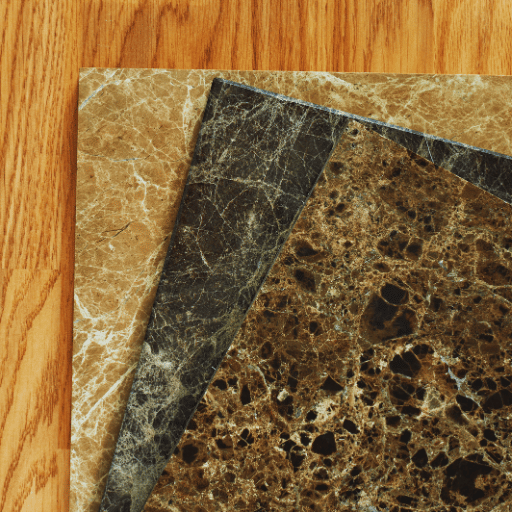
Granite typically has a density ranging from 2.63 to 2.75 g/cm³, while marble’s density ranges from 2.4 to 2.7 g/cm³.
| Parameter | Granite | Marble |
|---|---|---|
| Density (g/cm³) | 2.63-2.75 | 2.4-2.7 |
| Porosity | Low | Medium |
| Hardness | Hard | Softer |
| Durability | High | Moderate |
| Use Cases | Outdoor/Indoor | Indoor |
| Formation | Igneous | Metamorphic |
Granite vs. Quartz Density
Granite and quartz are renowned for their durability and strength, but they differ slightly in terms of density. Granite has a density of 2.63-2.75 g/cm³, whereas quartz typically has a slightly higher density of 2.65-2.70 g/cm³. This variation is due to the differences in their mineral compositions and formation processes.
| Parameter | Granite | Quartz |
|---|---|---|
| Density (g/cm³) | 2.63-2.75 | 2.65-2.70 |
| Porosity | Low | Very Low |
| Hardness | Hard | Very Hard |
| Durability | High | Very High |
| Use Cases | Outdoor/Indoor | Countertops, Surfaces |
| Formation | Igneous | Engineered or Natural |
Granite vs. Concrete Density
Granite has a density of approximately 2.63-2.75 g/cm³, while concrete typically ranges from 2.3-2.5 g/cm³ depending on its composition.
| Parameter | Granite | Concrete |
|---|---|---|
| Density (g/cm³) | 2.63-2.75 | 2.3-2.5 |
| Porosity | Low | Medium |
| Hardness | Hard | Moderate |
| Durability | High | Medium |
| Use Cases | Indoor/Outdoor | Construction |
| Formation | Natural | Mixed Material |
Geological Factors Influencing Density

Impact of Mineral Content on Density
Mineral content influences the density of a specific material. Take granite, which in nature is a mixture of quartz, feldspar, and mica. This rock is denser and more uniform than concrete. Quartz, one of the most abundant minerals in granite, has a density of approximately 2.65 g/cm³, which is within the range of granite densities. However, concrete does not have a constant density because it is a composite material composed of various components—water, aggregates, cement, etc. The addition of light aggregates, such as pumice, to concrete reduces the concrete’s weight. On the contrary, aggregates such as quartz or metals will produce a heavier product. This explains why the minerals present in rocks are essential factors when assessing material properties and suitability across different contexts.
Role of Formation Conditions
Several factors influence the density of granite and other igneous rocks. Minerals forming under high pressures tend to be denser, as their atomic arrangements are more closely packed. Similarly, the same logic applies to the properties of different minerals which are formed under various environmental conditions. Consequently, a material will be predominantly composed of denser minerals the higher the pressure and temperature at which it forms. On the other hand, certain impurities or pores present in the material itself may reduce density, depending on their formation. For instance, rapid cooling or formation at low pressure can determine the porosity of the resulting structure. It is essential to account for these conditions when examining or synthesizing the properties of geologic bodies.
Geological Variations in Granite Density
Granite varies in density due to differences in the minerals present and the geological conditions. The density of granite for most types is between 2.63 and 2.75 g/cm³ on average. Denser granites are found to contain more quartz and feldspar, whereas less dense granites contain more mica or other softer minerals. It is equally influenced by regional conditions, such as the cooling rate and the volatile compounds present in the rock at the time of its formation. For instance, granites in tectonically active regions tend to develop more compact structures and therefore have higher densities. Combining local geological materials with current resources enables researchers to estimate granite density at a given location using environmental parameters and historical literature for that area.
Reference Sources
-
The Effect of Fracture Density and Stress State on the Static and Dynamic Bulk Moduli of Westerly Granite: Explores how fracture density and stress states influence the bulk moduli of granite.
-
The Influence of Microcrack Density on the Elastic and Fracture Mechanical Properties of Stripa Granite: Investigates the relationship between microcrack density and the mechanical properties of granite.
-
Comparison of Calculated and Observed Crack Densities and Seismic Velocities in Westerly Granite: Discusses crack geometry measurements and their impact on the density and seismic properties of granite.
-
Coupled Evolutions of Fracture Toughness and Elastic Wave Velocities at High Crack Density in Thermally Treated Westerly Granite: Examines the effects of high crack density on the physical properties of thermally treated granite.
-
A New Paradigm for Granite Generation: Provides insights into granite formation, including density contrasts and structural analyses.
Frequently Asked Questions (FAQs)
How much does granite weigh and how do people find that out?
People usually find that the density of granite is between 2.63 and 2.75 g/cm³ (2,630–2,750 kg/m³). However, this figure depends on the minerals present in the stone and its porosity; therefore, local granite may weigh slightly more or less. This involves direct determination of mass and volume, which is especially helpful for odd-shaped samples and can be performed using the displacement of water or similar laboratory methods involving core plugs. High quartz content and a balanced feldspar formula, together with mica and a few other minor minerals, affect the rock’s mass.
When looking at granites, are they denser when compared to sedimentary rocks? What about in comparison with metamorphic rocks?
As intrusive igneous rocks, granites are primarily composed of large-grained crystals and have a relatively high density compared with other common rock types, such as sandstones and shales. However, in some instances they attain the same density as certain other rock types, such as gneiss. Granites are often preferred for such applications because they are crystalline in texture and, in general, have lower porosity than sedimentary rocks.
Is the density of granite different for different types of granites, and what are the causes?
Yes, because the density of granite varies with its constituent ratio: granular, high-quartz-content, light-colored granite, mica (muscovite and biotite), and biotite have different bulk densities. Granite’s host rock and pegmatite bodies can cause grain-size variations in localized areas. Changes in density arise from mineral proportions, grain size, and voids, as well as from modifications resulting from geological processes.
Why is the density of granite important in home improvement, particularly the installation of granite countertops, as well as its use for dimension stone?
The advantage of density in stone is evident in its role in enhancing the strength of granite countertops and other dimension stones, as it increases resistance to friction and wear. Due to its unique physical and mechanical properties, high compressive strength, and low porosity (which translates to high density), granite is often used to produce countertops and floor tiles.
How do the available granite deposits and batholiths influence the granite supply?
Granite deposits typically form large batholiths and plutonic bodies during magmatic events within the crust during orogeny. These granite-rich orogenic mountain regions and batholiths were sources of granite in the past and remain sources of granite blocks today. The volume of deposits and their accessibility determine whether certain stone types, such as granite blocks for paving and construction, are extractable.
Summary: Granite’s density, typically ranging from 2.63 to 2.75 g/cm³, is a critical property that defines its strength, durability, and suitability for various applications. From countertops to monuments, understanding the factors that influence granite density—including mineral composition, porosity, grain size, and formation conditions—helps us appreciate why this natural stone remains one of the most valuable materials in construction and design.


