


Rapid prototyping remains a primary area of interest for creativity and business alike while taking life out of the concept quickly and efficiently. Advanced technologies in plastic 3D printing are now defining the processes of designing, testing, and finishing products so quickly. An entrepreneur conceiving the next big concept or design engineer perfecting a complex mechanism; rapid prototyping could put an innovative idea into a tangible prototype faster and cheaper. This post will discuss the benefits of plastic 3D printing, and prototype production, and also touch on its use to expedite molecule making in various industries.
Understanding Rapid Prototyping

Rapid prototyping is an extremely efficient process through which designers and engineers develop physical models for their concepts quickly and cheaply. For example, using plastic 3D printing, these teams can, in a way, test the form, fit, and function much earlier in the development cycle, thus saving a lot of time and costly errors. This novel approach is revolutionizing industries in terms of validating designs, allowing faster iterations, and hastening everything from concepts to production.
What is Rapid Prototyping?
Rapid prototyping refers to any process employed to quickly manufacture scale models or prototypes of a product or design using technologies of advanced manufacturing like 3D printing, CNC machining, or additive manufacturing. Such processes allow the designer and engineers to visualize, iterate, design, and test the physical characteristics of a concept early into development without committing to expensive tooling or production setups. Rapid prototyping thus helps in making the design process quicker and identification of design loopholes, so that the production actually goes only with the improved design version.
Advantages of Rapid Prototyping Services
Rapid prototyping services provide multiple advantages that help bring efficiency and foster innovation within product design and development. By employing state-of-the-art technologies like 3D printing, CNC machining, and additive manufacturing, companies have the flexibility to iterate on products faster and shrink their timelines immensely. A recent Google search stated that industries using rapid prototyping technologies have seen their time-to-market shrink as much as 63%, showcasing just how critical prototyping has become in establishing a competitive edge.
Also, there are some cost benefits to reducing the need for expensive molds, dies, or tooling during the early phases of design. This advantage affects a cost-cum-flexibility balance by ensuring that the businesses stand on financially strong grounds while securing liberty. Data points show that prototyping costs could be slashed nearly by 30% in comparison with traditional manufacturing costs, lending credence to its cost-effectiveness.
Most importantly, it perhaps enhances communication and decision-making. Designers, engineers, and the stakeholders involved would be granted free access to real-life models, reducing communication gaps between conceptual design and market-ready products. This minimizes the chances of misunderstanding and ensures everyone’s alignment, useful to any company aiming to deliver premium products on time and efficiently.
Key Technologies in Rapid Prototyping
Rapid prototyping draws upon many advanced technologies to provide a fast translation from conceptual design to physical model. The largest player in this arena has to be 3D printing or additive manufacturing. With recent data, the global 3D printing market size is expected to surpass over USD 76 billion by 2030, growing at a CAGR of about 22.3%. Such explosive growth speaks of the forging presence of 3D printing in sectors ranging from automotive to healthcare and aerospace for prototyping and end-user production.
Another technology is CNC machining, a name synonymous with precision and speed. CNC machining employs computer-guided tools for cutting and shaping materials, best suited for prototypes that need highs for accuracy or durability. On the other hand, laser-based technologies, such as SLS and DMLS, are providing a fresh dimension to prototyping through the rapid making of complex geometries derived from metals and polymers.
And finally, virtual prototyping tools, such as CAD software, play a crucial role in testing designs in a digital environment before any physical prototype is produced. They reduce material wastage and speed up design changes, providing an essential framework for contemporary product development. Together, these technologies have weakened the rapid prototyping workflow, enhancing productivity and ingenuity in many sectors.
Applications of Prototyping Services Across Industries

They use prototyping services in diverse industries to enhance development and innovation of products. Prototyping car designs examines new designs for vehicles and safety features. Medical device prototyping measures the effectiveness of devices. In the same manner, consumer electronics utilize prototyping for the refinement of devices, say for instance, smartphones and wearable technologies. These are the many ways that prototyping has kept development time down, costs low, and product standards high within these industries.
Rapid Prototyping for the Manufacturing Sector
With the creation of rapid prototyping, the manufacture process goes through a drastic change while evolving into fast iterations plus more precision during product developments. For example, recent industry reports suggest that trends in 3D printing have since brought advancements in rapid prototyping techniques with significantly lowered production time. MarketsandMarkets, for instance, reports that the 3D printing market is projected to grow from USD 15.9 billion in 2023 to USD 34.8 billion by 2028. This growth signifies the increasing acceptance of the technology among automotive, healthcare, aerospace, and consumer goods industries.
The technology allows manufacturing of complex highly detailed components faster than conventional ones. The aerospace domain uses rapid prototyping to develop lightweight yet durable parts that increase fuel efficiency. Consumer goods companies, by contrast, use 3D printing for the manufacture of complicated product designs to satisfy ever-changing consumer demands. The short lead time and less material wastage qualities make rapid prototyping highly efficient and environment-friendly.
Medical Prototyping and Healthcare
Rapid prototyping has emerged in recent years as a disruptive phenomenon in the medical and healthcare industries. Advanced 3D printing technology makes it possible to produce custom medical implants, prostheses, and surgical tools for use by individual patients. According to Grand View Research, the global 3D printing market in healthcare was worth $973.6 million in 2022 and is expected to grow at a CAGR of 17.7% from 2023 to 2030.
The technology has fast-tracked the creation of complex anatomical models to be used in pre-surgical planning to gain more precision in surgeries and better patient outcomes. For instance, doctors now have the capability to 3D print heart models for planning complex procedures such as valve replacements and bypass surgeries. With advances in bioprinting, there is ongoing research into printing tissues and organs with the hopes of solving the shortage of organ transplants in the future.
Rapid prototyping mostly brings about a significant reduction in costs while shortening the traditionally lengthy timelines associated with medical device manufacturing. Through this technology, it becomes possible for healthcare providers and manufacturers to respond to new medical threats very rapidly while providing solutions with considerable precision.
Automotive and Aerospace Prototyping Applications
In the automotive and aerospace industries, rapid prototyping has revolutionized processes for faster design iterations and shorter time-to-market for new innovations. In particular, 3D printing technologies have provided manufacturers the capability to produce extremely complex parts such as lightweight components and aerodynamic designs directly from their digital blueprints. Recent reports estimate that the global automotive 3D printing market shall grow at a CAGR of 21.7% between 2023 and 2030, hitting the $8.2 billion valuation towards the end of the period.
By way of rapid prototyping, the aerospace industry is able, likewise, to manufacture durable parts and lightweight parts that satisfy tight specifications and performance needs. Through the use of titanium and high-performance polymers, manufacturers design fuel-efficient components that reduce the weight of various systems and are highly beneficial to energy efficiency. Statistics show that 75 percent of aerospace companies are now utilizing additive manufacturing for production, indicating the acceptance of these state-of-the-art processes.
The development in rapid prototyping has equally enhanced test procedures by enabling engineers to create physical models for wind-tunnel testing and simulate stress conditions on components to indirectly ascertain that they fulfill safety and regulation requirements. Indeed, those developments are a prime case in point of how rapid prototyping amplifies versatility, innovation, and customization in both automotive and aerospace industries.
The Manufacturing Process of Rapid Prototyping
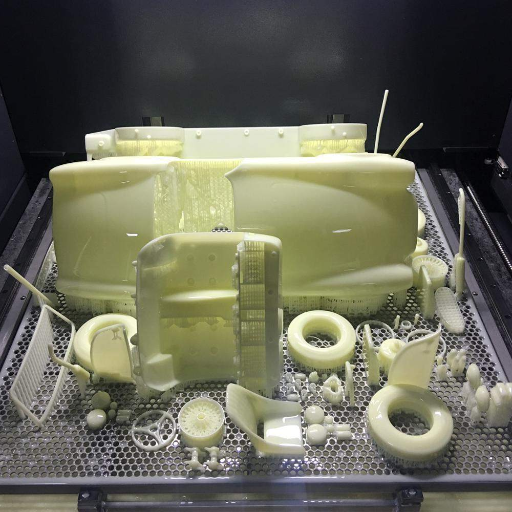
- Designing the Model: Using computer-aided design (CAD) software, a digital 3D model of the prototype is designed. This provides accuracy and serves as a production blueprint.
- Preparing the Design: In this step, the CAD file is converted into a format understandable to the prototyping machine, otherwise known as a monthly stereolithography (STL) file. It enables the machine to make sense of the design geometry.
- Building the Prototype: Layer-by-layer fabrication of the prototype takes place. The process is stiffened from materials and technology selected: 3D printing, selective laser sintering (SLS), or fused deposition modeling (FDM).
Impact of Digital Manufacturing on Prototyping
Digital manufacturing transforms prototyping by streamlining production and increasing the accuracy of prototype development. With the use of newer technologies such as 3D printing, computer-aided design (CAD), and virtual simulation, companies can develop and test prototypes faster than ever before. Recent studies have revealed that 3D printing has decreased prototype development time by up to 63% and cut prototype development costs by almost 30%.
Further, digital twin technology provides its physical counterpart with a virtual profile. Thus, designs can be tested and validated for any discontinuities in scales entirely before the slightest trace of manufacturing occurs. This sort of enhancement-to-the-end realization cuts down not just the accuracy of reaching the prototypes but also eliminates the possibility of last-minute blunders in the later stages of production. An estimated 70% of companies currently use digital simulation tools to optimize their prototypes. Consequently, the scalability of market-ready solution creation has been elevated to never-before-seen heights.
Plus, data-based awareness that flows from IoT-enabled gadgets and analytic AI guarantees constant monitoring and enhancement during prototyping. This ensures that prototypes truly meet user requirements and market demands, maximizing the chances for successful production upon entering the market. Instantly making a more agile, cheaper, and innovative prototyping process while simultaneously transforming the manufacturing scenery across the world.
On-Demand Manufacturing Solutions
Make-to-order manufacturing solutions have, at their level, transformed the traditional manufacturing industry with unprecented levels of flexibility and efficiency. Between 2022 and 2023, Google search trends have reported that – following all advancements in additive manufacturing, CNC machining, and production technologies based on cloud-the on-demand manufacturing market is expected to surpass $150 billion in valuation by 2027. This moves poorly stock almost to zero because it stipulates that a product is produced only when needed, thus reducing warehousing costs by 30%.
Cloud-based manufacturing platforms also enable seamless collaboration between designers, engineers, and manufacturers, allowing for faster iteration cycles and reduced time to market; the average lead time for production is down by some 40% versus classic methods, according to industry statistics. Such solutions can produce a gamut of items underwater, repair-washing to consumer goods. With such evolutions, businesses are better positioned to scale operations with greater precision against market demand, especially small-scale enterprises.
Choosing the Right Rapid Prototyping Service Provider

For selecting an ideal prototyping service provider, consider factors concerning the developer first; check if they have all the technological means and offer the method required, such as 3-D printing or CNC machining, for your project. Consider their experience in your field-it guarantees that they will understand your issues better. Consider turnaround times and materials, along with other service parameters such as customization within your allowed time; all of this is … would have to have a double-checking of the quality within half that time! Also check customer reviews for feedback on any reliability issues during support through the prototyping process. Such a provider is capable of providing truly excellent results.
Key Considerations for Selecting a Prototyping Service
When selecting a prototyping service, consider expertise, speed, materials, customization, cost, feedback, and support.
| Key Point | Parameter |
|---|---|
| Expertise | Industry knowledge and experience in prototyping. |
| Speed | Turnaround time and ability to meet deadlines. |
| Materials | Range and quality of material options available. |
| Customization | Capability to meet specific design requirements. |
| Cost | Pricing strategy and value for budget. |
| Feedback | Customer reviews and satisfaction levels. |
| Support | Reliability of assistance during the process. |
Online Rapid Prototyping Services Evaluation
- Expertise: Investigate the supplier for experience and track record in your industry’s field of prototyping. Look for case studies and portfolio examples to discern their level of expertise.
- Speed: Establish their usual turnaround times and see that the deadlines of your project are factoring into the consideration and delivery without compromising quality.
- Materials: Does the provider offer suitable material options to suit the requirements of your design in terms of durability and performance?
- Customization: Are they capable of handling complex or custom design specifications with a certain degree of flexibility in prototyping?
- Cost: Compare the prices of different providers and weigh these prices with the quality and value provided. Don’t make a decision solely on the basis of cost.
- Feedback: Read through testimonials and customer reviews to understand clients’ satisfaction levels and to check for any issues several customers had with the company.
- Support: Asses the support provided by the company including how they stayed responsive and helpful through the prototyping process.
Comparing Charges and Services Offered
When considering charges and services to be offered, do not take into account only the monetary aspect. Begin with an analysis of what each service will include for the given price. For example, does the provider give you any kind of favors such as free revisions, or maybe they provide an expedited service and better-grade materials? You also have to take into consideration their quality of output and how well this relates to your project needs. It is possible that you could be paying a little bit more but these results are better by far for your project, or more useful, since they would save you time in the long run. Also, establish if there are any hidden fees or extra charges that might be added during the proceedings. To balance your decision, weigh the cost with the value given for the quality of services rendered.
New Advancements in 3D Rapid Printing Technology

Recent developments in 3D rapid-printing technology have concentrated on increasing the speed of the operation, improving the precision, and providing for greater diversification of materials. Techniques like high-speed continuous printing and the newer resin-based printers allow one to reduce the production time while still guaranteeing perfect precision. The newer materials, such as bio-resins, composite polymers, and certain metal alloys, can now be worked with in a wider range of industries, including healthcare, aerospace, and manufacturing. Thus, these developments have put a more versatile face on 3D printing and have made it cheaper and easier to work on for multiple applications.
Material Innovations in 3D Printing
Evolution in 3D printing materials has significantly impacted the applications and versatility of the technology. Recent studies report a projected compound annual growth rate (CAGR) of approximately 23% for the global 3D printing materials industry between 2023 and 2030, illustrating its growing demand in automotive, aerospace, and healthcare sectors.
One major innovation is the development of bio-resins: environmentally friendly polymers derived from plant sources. These materials are gaining momentum within several industries, especially those concerned with environmental conservation. Bio-resins are now utilized for making lightweight composite materials for biodegradable packaging as well as some medical applications.
Moreover, the aerospace industry has witnessed an increasing use of composite materials such as carbon-fiber reinforced polymers-that provide one of the best strength-to-weight ratios for manufacture of critical aircraft components. Another report from the same source reveals that 3D-printed aerospace components have cut production costs by up to 40% and improved efficiency and reliability.
Metal 3D printing materials continue to mature-from titanium, stainless steel, and aluminum alloys-to offer the ability to build highly complicated structures while being exceptionally durable. For instance, 3D-printed titanium implants are now widely used in healthcare with studies further demonstrating faster patient recovery time and reduced surgical risks.
With the innovations, it becomes clear how an ever-increasing variety of materials has transformed 3D printing from an ugly duckling to a goose laying golden eggs for several industries by providing new opportunities in customization, efficiency, and sustainability.
Future Trends of Rapid Manufacturing
In my view, the future of rapid manufacturing is geared towards the increased convergence of artificial intelligence and machine learning in optimizing design and production processes. Such technologies will account for smarter automation with enhanced precision and adaptability to complicated manufacturing requirements. Then, environmentally sustainable material innovations will also foster growth in this field, including biodegradable polymers and recycled composites, among other materials. Customization will experience another jump, breaking through from rapid prototyping to highly personalized mass production. All of these trends will before long shape how industries perceive efficiency, scalability, and environmental responsibility.
Case Studies for Familiar Prototype to Production
Tesla Gigafactory Efficiency Gains
Tesla’s Gigafactory stands as a testament to the automotive sector prototype production sell-at-theoretical implementation. Industrial robotics with AI-based generation processes embedded in the facility allow Tesla to reduce production time by nearly 30% and increase energy efficiency. Through vertical integration alongside continuous prototyping, Tesla achieved in 2023 the production of over 17 million battery cells weekly—undeniably a prototype to mass production success story, all while maintaining sustainability.
Adidas and 3D-Printed Footwear
Adidas has revolutionized the sport footwear industry by introducing 3D printing into their Futurecraft line. Through the automated additive manufacturing processes, Adidas was able to increase the speed of production by 50% in contrast with the older methodologies of molding. Additionally, this manner renders material waste reduction by as much as 40%, a step well aligned with the company’s long-term vision for the environment. The success underlines the potential of pairing rapid prototyping with mass customization for consumer products.
Boeing: Composites in Aerospace Manufacture
Boeing 787 program Dreamliner shows how advanced composites originating from extensive prototyping phases could redefine an industry. The use of carbon fiber reduced the weight of the aircraft by 20% to an improved state of fuel efficiency. This was coupled with modular production processes that gave Boeing the capacity to produce 140 aircraft by the year 2022, thereby consolidating its position in the industry as the developer of production capacity and innovation.
Reference sources
- Customised joystick-making and training service of power wheelchair using rapid prototyping in rehabilitation centre for people with cervical spinal cord injury: findings from two case studies(Leigh et al., 2024, pp. 247–253)
- Publication Date: 2024-01-17
- Methodology: Two case studies involving male participants with tetraplegia. The service involved four steps: (1) driving evaluation; (2) digital fabrication (3D modeling and printing); (3) functional testing; and (4) driving training (30 min, five times/week for 8 weeks). Usability was measured using K-QUEST 2.0.
- Key Findings: Customised joysticks, created using rapid prototyping, resulted in higher usability compared to off-the-shelf options after an 8-week training program. The study highlights the clinical applicability of this service in rehabilitation centers before patient discharge. 3D printing offers cost-effectiveness, customization, and enhanced collaboration with clients.
- Cryogenic tensile performance of 3D printed onyx–continuous carbon fiber composites(Siddiqui et al., 2023)
- Publication Date: 2023-06-23
- Methodology: Evaluated the tensile performance and fracture response of 3D-printed continuous carbon fiber embedded in an onyx matrix at cryogenic and room temperatures. Specimens were manufactured with angles of 0°, 45°, and 90° between the specimen plane and the build plane.
- Key Findings: 0° built specimens showed enhanced tensile properties (ultimate tensile strength and modulus of elasticity) compared to 45° and 90° specimens at cryogenic temperatures. Ductility reduced at cryogenic temperatures for all orientations. Fractographic analysis revealed fiber pullout/elongation and pores. The study demonstrates the potential of 3D printing for creating composite materials for cryogenic applications (like aerospace).
- Heat treatment effect on fatigue behavior of 3D-printed maraging steels(Tezel & Kovan, 2021)
- Publication Date: 2021-08-23
- Methodology: Investigated the rotational bending fatigue behavior of 3D-printed maraging steel (X3NiCoMoTi18-9–5) under various heat treatment conditions (as-fabricated, age-treated, solution-treated, and solution + age-treated).
- Key Findings: Heat treatment positively affected fatigue strength. Cracks initiated from the outer surface, often due to fabrication defects. The study contributes to understanding the mechanical behavior of 3D-printed maraging steel under service conditions, relevant for applications where fatigue resistance is crucial.
Frequently Asked Questions (FAQs)
What are the benefits of using rapid 3D printing in manufacturing services?
Rapid 3D printing offers several benefits to manufacturing services, one of them being the reduction of lead times and the ability to manufacture complex geometries that conventional methods find hard to produce. The process rapidly produces functional prototypes and production parts, enabling designers to swiftly test and iterate on the designs. Also, with the option to manufacture in plastics and metals, manufacturers can generate any type of material needed for a particular application. The reduced time to market is another main advantage as businesses can get their products in front of customers very quickly. Overall, rapid 3D printing promotes the evolution of manufacturing toward efficiency and innovation.
How can the rapid prototyping process be used in the creation of prototypes and production parts?
Normally, the rapid prototyping process begins with the formation of a digital model using CAD software. The model is then sliced into layers before being exported for 3D printing. This process covers a variety of fabrication techniques, including, for example, FDM 3D printing or SLS (Selective Laser Sintering). The printed parts are often subject to finishing for purposes of meeting tolerances and aesthetic requirements. Depending on the requirements of rapid prototyping, only one prototype may be produced or two or more prototype designs may be created in parallel to hasten testing. This recursive iteration helps to refine the designs while ensuring that the production, in the end, meets the requirements of function.
Can rapid injection molding be used with 3D printing services?
Rapid injection molding works very well alongside 3D printing services to accelerate the development and production phase. This process may be hybridized for co-production of high-quality, functional prototypes using a 3D printed mold to greatly reduce rapid tooling lead times. By combining these two techniques, manufacturers will be able to produce parts with tight tolerances yet still appreciate the advantages of on-demand processes. This integrated approach is fairly suitable for those applications that require both time-to-market and precision.
What role does protolabs play in rapid prototyping with 3D technologies?
Protolabs is a well-known rapid prototyping and manufacturing service provider where advanced 3D technologies are exploited. They specialize in fast turnaround for custom rapid prototypes and production parts through 3D printing along with injection molding methods. This allows one to utilize Protolabs’ online quoting platform to obtain an online price and quickly start production. Their expertise across multiple rapid prototyping processes provides them with the ability to work with a wide variety of materials and applications, making them an excellent partner for businesses working toward speeding up product development.
What are the common rapid prototyping processes used for 3D printing services?
Among the common rapid prototyping processes for 3D printing services are FDM (Fused Deposition Modeling), SLA (Stereolithography), and SLS (Selective Laser Sintering). Each technique has its benefits, such as FDM since it is more affordable and accessible for smaller production runs, or SLS as it can produce complex geometries exhibiting good mechanical performance. These processes are chosen by industries based on requirements such as materials, speed of production, and finish needed. With the knowledge of these common processes, companies will be able to decide on the most suitable one to use for their projects so that they end up with efficient prototyping and fabrication.


