


Being a warm-toned and versatile material, brass is highly favored among craftsmen and manufacturers. But when it comes to accuracy cutting, people must ask themselves whether CNC routers can do the job or not. This question particularly comes up for hobbyists-and-for-pro-yourself. We want to find efficient ways to shape brass for stylish designs or pretty pragmatic pieces. In this article, we shall study the CNC Router capabilities regarding brass cutting, what problems are confronted, and how we handle these problems into clean and more precise cuts. The guide will help you make knowledge-based decisions if you are new to working with brass or would like to improve your working technique.
What Is a CNC Router and How Does It Work with Brass?

A CNC router works by means of programmed instructions on the computer to cut and shape materials. It works with brass as it contains cutting tools controlled by a computer program, which carve the brass into the desired shape. As a relatively soft metal, brass is good to work with on CNC routers when proper settings are observed so as not to cause excessive heat or accelerated tool wear: feed rate and type of cutting tool and cooling system are all used in achieving a nice, clean cut with great accuracy.
In-Depth Concept of CNC Router
A CNC router has revolutionized manufacturing and fabricating far beyond its ordinary capacity of precision. All CNC routers perform under G-code programming and specific instructions for cutting, drilling, and shaping materials. These machines are versatile and are unusually capable of cutting metals, wood materials, plastics, and composites.
CNC routers require special settings to perform best when working with brass. Typically, a spindle speed of between 2,000 and 3,000 RPM is recommended, depending on the tool’s diameter and the thickness of the material. Feed rates for brass typically range from 0.05 inches to 0.15 inches per tooth to ensure smooth cutting without generating too much heat that can damage the brass material and the cutting tool. For the best results, the machining process should be supported by effective use of coolants, such as water-soluble oils.
The CNC routers have reportedly held tolerances to within ±0.001 inches, ideal for ultra-detail work on complicated designs, according to a more recent survey of the industry. Hemmendinger continues, stating that with the advent of CNC software, automation has skyrocketed, reducing operation times by up to 40 percent and increasing productivity. Today, high-end performance CNC routers can be interfaced with CAD and CAM software, linking the entire design-to-production scene.
Knowing these parameters, together with all the facilities provided by modern CNC technology, will allow the user to fully exploit the capabilities of a CNC router, especially when it concerns brass. Mixing good design and execution, a CNC router will guarantee quality and lower material wastage, making it a big factor in precision manufacturing.
Metal Materials Working
Within manufacturing fields, brass is highly desired because of its machinability, corrosion resistance, and pleasing appearance. Setting appropriate tooling and machine parameters is crucial when machining brass on a CNC router. For example, using sharp, high-quality carbide tools would enhance precision and lessen tool wear. If speeds and feed rates are controlled properly, the material will not overheat, leading to smooth, clean cuts.
The mitigation of heat can also improve the machining process for brass. Suitable application of cutting fluids reduces friction, increases tool life, and provides a high-quality finish. In combo with the appropriate tools, techniques, and attention to detail, CNC routers make machining brass consistently yield great results.
CNC Router Applications in Metalworking
Due to their precision, speed, and versatility, CNC routers have revolutionized the metalworking world. When CNCs are put to work on metals such as brass, aluminum, and steel, manufacturers are able to produce very complicated designs, custom components, and high-quality finishes with amazing accuracy. CNC routers can be used for prototyping on small scales and mass production on a large scale, with the smallest of error margins, thereby boosting productivity.
One application lies in aerospace, where CNC routers are used to machine lightweight, precise metal components critical for aircraft. To give an example, aluminum is machined to make important parts such as wing braces and engine components, prized precisely for its high strength-to-weight ratio. CNC routers for body panels, exhaust pipes, and complicated engine components are utilized in the automotive sector to ensure tolerance and consistency in quality. According to reports, CNC routing improves dimensional accuracy by as many as 30 percent compared with conventional machining methods, resulting in reduced waste and operating costs.
Similarly, CNC routers are widely employed in jewelry manufacture to create detailed and custom designs in precious metals like gold and silver. This use has transformed the industry by allowing for high-speed production without compromising the fine level of detail required by traditional manufacturing techniques. Likewise, they are used in architectural and decorative metalwork to fabricate ornamental panels, sculptures, and fixtures with excellent detail.
Market research reports suggest that the metal CNC router market is forecast to grow at a CAGR of greater than 5% from 2023 to 2030, with this growth attributed to the growing demand for precision-manufactured metal components in electronics, medical device manufacturing, and renewable energy, to name a few. For instance, CNC routers are essential in the production of heat sinks for electronic equipment and metal implants for surgical operations.
From industrial-functional parts to artistic design, CNC routers have been both innovative and pragmatic tools in driving the transformation of the metalworking industry. Right from their inception, the melding of advanced software and hardware has shaped the growing number of applications as well as the industry prevalence of these machines.
Is it Possible to Cut Brass Using a CNC Router?
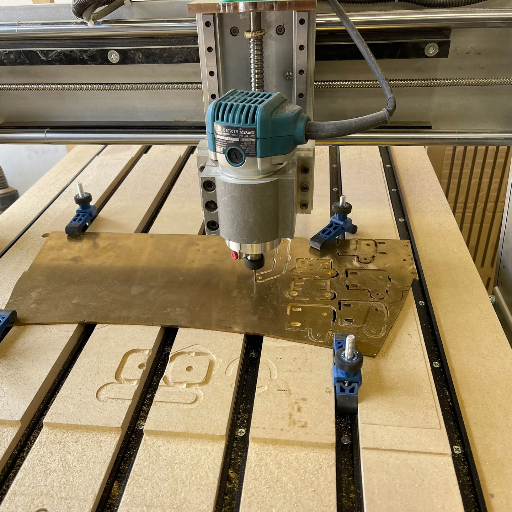
Yes, one can cut brass using a CNC router. Brass is a soft metal and thus can be machined with the right tools and settings. In order to produce fine and accurate cuts, a sharp bit considering the best quality of bits for metal must be used. Further, the speed of the router must be kept to a point wherein the feed rate can remain stable throughout the cutting action. Other factors include ensuring the proper securing of the working area so that movement does not take place, while lubrication will also prove to be useful in aiding the process and reducing wear on the tooling.
Challenges When Cutting Brass on a CNC Router
Machinists may be faced with quite a few challenges while trying to cut brass with a CNC router. Heat buildup is chiefly one of the difficulties encountered during the cutting process. Since brass is a conductor of heat, inappropriate speeds or feed rates could cause heat buildup, and this might cause wear on the tool or deformation of the workpiece itself. Cooling with lubricants or air forcible blows can help to solve this problem.
Another issue is the threat of vibrations and chatter, which cause rough edges and decrease the accuracy of the cut. This issue can usually be rectified by tightly securing the workpiece and ensuring CNC router settings like spindle speed and feed rate are matched to brass softness and thickness. Experts recommend spindle speeds from 12,000 to 18,000 RPM, but feed rates vary between 300mm/min and 1,200mm/min, depending on the bit and machine used.
The wear of tools is another issue faced by machining brass. Although softer than many other metals, the use of wrong cutting tools or low-quality bits for brass results in premature wear or breakage. Carbide or high-speed steel (HSS) bits are suitable for cutting brass because they are in fact very durable and remain sharp.
They can produce very fine chips, which tend to clog the cutting path or damage the router if left unattended. Chip removal should be done frequently using vacuum systems or air pressure to ensure a clean working environment.
Putting these challenges into consideration and actively working to solve them will definitely aid machinists in extracting maximum efficiency and accuracy from CNC router brass-cutting processes, resulting in the best possible outcome. Following best practices, including optimizing machining settings, workpiece fixation, and tooling selections, will greatly decrease the likelihood of encountering related problems.
Advantages of CNC Router Cutting of Brass Sheets
CNC routers allow precision cuts with consistency, which is hard to obtain with manual methods. They help create intricate designs and perform accurate measurements that minimize waste in terms of raw material and thereby offer good final results. With high levels of efficiency due to their professionalism in cutting, CNC routers provide faster operation times with the least amount of human error. Hence, CNC routing can execute manufacture and smaller batch fabrication.
Comparing Cutting Brass vs. Cutting Aluminum
Cutting brass involves greater hardness and requires lower cutting speeds compared to cutting aluminum, which is softer and allows higher cutting speeds but often requires lubrication to avoid overheating.
| Key Point | Brass | Aluminum |
|---|---|---|
| Hardness | Higher | Lower |
| Cutting Speed | Lower | Higher |
| Lubrication | Less needed | Often needed |
| Tool Wear | Moderate | Lower |
| Heat Resistance | Higher | Lower |
| Intricate Cuts | Easier | Can vary |
| Material Cost | Higher | Lower |
| Durability | Stronger | Softer |
| Finish Quality | Excellent | Good |
| Waste Generation | Lower | Moderate |
What Types of Tools and Bits Are Suitable for Cutting Brass?

- Saw Blades: Fine-toothed blades, such as those on a hacksaw, are ideal for cutting sheets or rods of brass.
- Drill Bits: Use high-speed steel drill bits to prevent wear of the cutting surface and obtain clean holes.
- Milling Bits: Carbide-tipped milling-flutes or square end mills should be used for the finest detail and accuracy.
- Lubrication: Brass does not always need lubrication, but a very thin application of oil does help maintain smooth cutting and churning out heat.
Choosing the CNC Router Bits
The appropriate CNC router bit for cutting brass should be a carbide-tipped bit designed for non-ferrous metals, durable enough to ensure clean, precise cutting. Single-flute or O-flute bits are highly recommended for efficient chip removal and heat reduction. The size of the bit should be proportional to the thickness of the brass that you will be working with.
Importance of Carbide Tools
Using carbide tools to cut brass is important for utmost finish. Carbide being much harder than HSS will remain sharper longer, resulting in less tool wear and more production time, especially in materials like brass that rapidly deteriorate tools if the wrong tools are used.
From industry insights, carbide tools last as long as 10 times more than HSS tools, making them a worthy investment notwithstanding their initial high cost. The greater hardness and heat resistance of carbide enable higher cutting speeds and feeds, reducing machining times without compromising surface quality. Moreover, in CNC machining operations, carbide-tipped single-flute or O-flute tools are excellent for brass by providing good chip evacuation and reducing heat build-up that could distort the material or damage the tool.
Also, studies have hinted that the precision provided by carbide tools leads to better finishes, thus cutting down on extra post-machining operations such as sanding or polishing. When the correct tools are employed with proper feed rates and spindle speeds, operators can greatly enhance both the quality and efficiency of their projects.
Recommended Spindle Speeds and Feed Rates
Picking the right spindle speeds and feed rates holds more importance when trying to better the machining performance to meet expectations with high-quality results. These may vary depending on the material one is machining, the tool being used, and the result after machining. Below are some common suggestions as advised and gained through the most prestigious works.
- For Brass: Brass is a soft material, thus allowing for higher spindle speeds. Speeds of about 2,000 to 4,000 RPMs (revolutions per minute) and feeds of about 0.05 to 0.3 mm per revolution seem to be acceptable. The higher the speed, the better the surface finish; with overheating, however, one must be careful.
- For Aluminum: Aluminum supports high spindle speeds, usually ranging from 3000 to 6000 RPMs, combined with feed rates of 0.1 to 0.5 mm per rev. Reduced feed rates may be necessary for intricate machining and tight tolerances to prevent tool chatter.
- For Steel: Steel machining calls for lower spindle speeds due to the hardness level of steel. Generally, spindle speeds range from 800-2000 RPM, contingent on the nature of steel (mild or hardened) with feed rates oscillating within 0.05-0.2 mm per rev. Appropriate cutting fluids should be employed with these processes to suspend heat while aiding tool life.
- For Plastics: The plastics are light and could melt with the application of heat. The spindle speed is characterized between 1,000 and 3,000 RPMs with the feed rate set around 0.1 to 0.4 mm per rev, all dependent on type of plastic and its thermal behavior.
When configuring these parameters, other factors such as tool diameter, coating, and geometry also come into play. For example, lower spindle speeds are usually required by larger diameter tools, whereas those with advanced coatings such as TiAlN can operate at higher speeds. Additionally, consider the manufacturer’s specification of the cutting tool you are using and conduct some trails to pinpoint the exact setting.
These guidelines emphasize that a good balance between speeds and feeds will increase tool life, good surface integrity, as well as, eliminate problems such as tool wear and film distortion.
How To Get The Best Surface Finish When Cutting Brass?

- Make Use of Sharp Tools: Always ensure cutting tools are sharp for a smooth and clean cut.
- Cut With Appropriate Speeds: Never resort to too high speeds to ensure heat generation is avoided; that will help bring out a polished finish.
- Cool It Off: Apply refrigerants or lubrication wherever possible to reduce friction and promote surface quality.
- Vibration Minimization: Hold the workpiece firmly while moving the tool at a steady pace so as to avoid vibrations that cause uneven cuts.
- Tool Geometry: Brass-specific tools tend to chip less, thus giving a better finish.
Techniques for a Smooth Finish
Smooth finishing is achieved by a perfect blend of fine finishing techniques, cautious handling of materials, and correct tools. Here are some of the better techniques that will guarantee you good results:
- Abrading with Abrasives: Use fine sandpaper of approximately 600-1200 grit or abrasive pads crafted for metal surfaces to polish the surface once machining is complete. Circular motion must be used to avoid uneven blending of the surface with horizontal abrasions. This works incredibly well with brass where aesthetics are essential.
- Buffing and Polishing Compounds: Following the polishing compounds are applied using a buffing wheel to further enhance surface luster. For brass, rouge-type compounds are ideal to achieve mirror finishes. It has been proved that surface smoothness can be increased up to 15% by the combined use of mechanical and chemical polishing.
- Electropolishing: An advanced polishing technique where materials are removed microscopically by using an electrolytic bath. Studies have revealed that this method can reduce surface roughness by over 30% when compared to conventional ones. This type of polishing is appropriate for precision polishing of complex brass components.
- Ultrasonic Cleaning: Ultrasonic cleaning cleans away any debris remaining after polishing, such as fine metal particles or traces of polishing compound. Ensuring an uncontaminated surface is crucial for subsequent plating or coating processes.
- Proper Maintenance of Tools: Flawed or dull tools deteriorate surface finishes; hence, regular sharpening and maintenance of cutting tools are required. Statistics show that percentages of about 20% in surface defects during machining can be reduced if the cutting tools are sharp.
- Control Cutting Speeds and Feeds: Adjust the cutting speed and feed during machining to reduce heat generation from the machining process and to avoid misleading vibrations or chatter of the cutting tool on or from the workpiece surface. Lower speed plus steady feed rate have a great effect on reducing surface imperfections.
Combining these advanced techniques and processes gives you a finish that not only looks good but is consistently reproducible for technical designs or exceptionally demanding work.
Use Coolants and Lubricants
Proper use of cutting fluids has been recognized worldwide to provide the best surface finishes with maximum tool life. Mainly, a coolant is used to control heat generated at a cutting zone during machining, while a lubricant aims to reduce friction between the cutting tool and the workpiece. Studies have shown that proper coolant usage can reduce the temperature of machining by 50% to maintain material integrity and avoid thermal distortions.
High-performance lubricants, when used appropriately, make cutting operations smoother due to lesser wear and better surface finish. Recent studies show that synthetic or semi-synthetic cutting fluids are better than conventional ones by 30% in friction reduction efficacy. A type of new fluid delivery system called minimum quantity lubrication (MQL for short) has grown in popularity by maximizing lubricant usage while producing superior results, particularly in areas where ecological concerns must be considered.
By making the proper selections and by proper management of coolants and lubricants for respective materials and cutting conditions, manufacturers can give a great boost to machining performance, while cutting down on costs and environmental hazards.
Polishing Brass After Cutting
To polish brass after cutting, I first use fine sandpaper or a deburring tool to remove any debris or burrs left from the machining. Then, the surface gets washed with a mild detergent and water to wash away any oils or residues. The brass is then dried, and the polishing compound is applied using a soft cloth, rubbing in circular motions until the shine desired is achieved. For intricate work, I employ a soft-bristled brush to get into all the nooks. The surface is then wiped clean again, and at times, I put down a protective coat to keep the finish.
What Are The Common Mistakes While Cutting Brass in CNC Router?

- Using Improper Feed and Speed – Improper cutting speed or feed rate generates excessive heat that deteriorate the quality of the cut and or damage the tool.
- Wrong Cutting Tools – Using those types of tools that are not intended for brass application causes chipping and uneven edges or quickly deteriorate the cutting edge.
- Not Clamping the Material Properly – The material will be subjected to movement while cutting whenever sufficient clamping force is not applied, thus inculcating errors in the dimensions or damaged in the workpiece.
- Not Maintaining Tools Well – Poor finishing and chances of machining errors exist where tools are dull and damaged.
- No Cooling Action – Brass generates heat during the machining; lack of either cooling or lubrication will cause unwanted distortion of the material as well as of the tool.
Avoiding Tool Breakage and Blocking
Unfortunately, tool breakage and blocking duly occur, especially during machining with a material such as brass. To cure these impediments, right method and tools, as well as parameters should be used. Here are the points to consider:
- Using Good Tools: Buying good quality cutting tools made for brass will help reduce the wearing out. For example, carbide tools are well-known for their durability and resistance to heat.
- Picking Cutting Parameters Carefully: One needs to consider cutting speeds and feed rates for the particular kind of brass and the tool being used. For example, general recommendations for turning brass introduced cutting speeds of 300-600 SFM (Surface Feet per Minute), depending upon the kind of alloy and tool material.
- Design to Maximize Chip Control: Brass chips that are small and sharp can clog the tools. Using tools designed for breaking chips or applying high-pressure coolant could clear chips more effectively.
- Cool and Lubricate Properly: Overheating is the main reason behind tool damage and clogging. The proper use of coolant and lubricant will ensure that heat is minimized and the chips are slid away smoothly. Statistics state that the use of coolant would increase tool life by 50%.
- Maintenance of the Tool: Frequent checks must be made on wear, chipping, or build-up at the cutting edges to ensure tools remain in good working condition, thus minimizing failure halfway through an operation.
The adoption of these will significantly reduce the risk of tool breaking and clogging, thus smoothing the operation, improving the efficiency, and product quality, especially in concert with the latest machining technologies.
Worse Management of Swarf and Chip Load
If swarf and chip loads are not well managed, they can deteriorate machining operations. Accumulation leads to tool damage, loss of precision, and also machine downtime. To prevent this, chip breakers and strict disposal of chips should be considered. The chip breaker acts to break swarf into smaller chunks to avoid tangling and clogging. Optimizing cutting parameters such as feed rate and spindle speed also controls chip formation. High-pressure coolant execution flushes chips away from the cutting zone which keeps the area clean and prevents thermal impact on the tool. Executing these actions promotes lubrication of the process and improves productivity whilst preventing unnecessary wear and tear on the tooling and machinery.
Ensuring Rigidity and Reducing Deflection
Maintaining rigidity during machining processes is paramount to achieving accuracy and reducing tool deflection. Excessive cutting forces cause tool deflection with dimensional inaccuracies being produced and poor surface finish achieved with faster tool wear. One of the key methods to reduce deflection is owning short tool overhangs. Recent data show that reducing the tool length-to-diameter ratio translates to as much as 50% deflection reduction, thus greatly enhancing machining stability.
Additionally, selecting strong tool materials of carbide or coated carbide type enhances rigidity; these materials are much more resistant to bending or thermal deformation than conventional high-speed steel tools. Machine tool rigidity comes along with importance here, where advanced CNC machines with either cast-iron or polymer-composite structures demonstrate better damping and stability. Studies show that using fixtures, which are designed to securely clamp the workpiece, can reduce vibration levels by as much as 40%, thus ensuring consistent dimensions and quality.
Another crucial aspect is the optimization of cutting parameters. Reducing either the depth of cut or the feed rate helps to decrease cutting forces and therefore reduce deflection. Applying simulation or computational tools to calculate an optimum parameter setting supports a balanced approach between productivity and accuracy. By employing these techniques, manufacturers can guarantee improved performance, prolonged tool life, and tighter machining tolerances.
Reference sources
- Optimization of wood machining parameters using artificial neural network in CNC router (Cakmak et al., 2023, pp. 1728–1744)
- Key Findings:
- Optimal machining parameters were determined for machining Fagus orientalis, Castanea sativa, Pinus sylvestris, and Picea orientalis wood samples at different moisture contents using a CNC router.
- An artificial neural network was used to model the surface roughness and cutting power during the machining process.
- Methodology:
- Wood samples were machined on a CNC router in both across and along the grain directions.
- Experimental data on surface roughness and cutting power were used to train and select the best artificial neural network models.
- Optimal machining parameters were determined based on the trained models.
- Key Findings:
- Utilizing CNC Router Machine to Construct a Prototype Incorporation Principles of Solid-based Rapid Prototyping Process and Interlocking Brick Design (Rianmora et al., 2024)
- Key Findings:
- A novel approach was proposed to revolutionize rapid prototyping through the use of interlocking brick design and a CNC router.
- This method eliminates the need for adhesives, simplifying assembly and enhancing structural integrity.
- Key parameters, including FEA analysis, 3D slicing, tool selection, and material choice, were critical in achieving the desired outcomes.
- Methodology:
- Bricks were designed through CAD and FEA analysis to optimize their mechanical properties.
- The 3D virtual model was sliced into layers matching the brick thickness and fabricated using a CNC router.
- The comprehensive strategy aligned with a waste-to-wealth concept, integrating sustainable practices into the manufacturing process.
- Key Findings:
- Analisa Burr Pada Proses End-Milling Baja Karbon Lunak Profil Siku Menggunakan CNC Router (Mazwan & Haripriadi, 2024)
- Key Findings:
- The study investigated the formation of burr during the end-milling of soft carbon steel with a CNC router.
- Spindle speed was the primary parameter affecting burr formation, followed by depth of cut and cutting fluid type.
- Dry machining was found to increase burr growth.
- Methodology:
- Experiments were conducted using the Taguchi orthogonal array design and ANOVA analysis to determine the influence of cutting parameters on burr formation.
- Soft carbon steel samples with an L-shaped profile were machined using a CNC router.
- Key Findings:
- Top Brass CNC Machining Parts Manufacturer and Supplier in China
Frequently Asked Questions (FAQs)
Q: Can CNC routers cut brass tappably?
A: The answer is yes, a CNC router can cut brass effectively but with certain settings and with the right tools. The tips and tricks to do it well should involve appropriate flutes and cutters.
Q: What cutters should I use to cut brass on my CNC router?
A: Small cutters with minimum two-flute carbide end mills are recommended for brass cutting, delivering cleaner cuts with little chance of damage to the material.
Q: Should I worry about cutting oil while routing brass?
A: Using cutting oil when routing brass is recommended: it reduces heat and friction while also ensuring a finer finish and prolonging cutter life.
Q: What DOC (Depth of Cut) per pass do I need to achieve for cutting brass?
A: When cutting brass, consider shallow DOCs per pass-of about 0.005″ to 0.015″-to avoid excessive wear on the tool and provide for cleaner cuts.
Q: If I want to know more about cutting brass, will a Onefinity CNC forum help?
A: Yes, surely; the Onefinity CNC forum is a wonderful source for tips and tricks on cutting brass and other metals, where users exchange valuable experiences and best procedures.
Q: What spindle speed (RPMs) do I use to cut brass?
A: The RPM range for cutting brass should be lower than that for softer materials and generally runs between 8,000 and 12,000 RPMs, depending on the cutter and your own set-up.
Q: Should I consider a rigid setup while cutting brass on the CNC router?
A: Absolutely; rigid setup is of importance to avoid vibration during brass cutting and get results with utmost precision. This means firmly locking the workpiece in place and, if at all possible, setting it on an industrial-grade CNC router.
Q: What about colteting when cutting brass?
A: The collet holds the cutter and should be tightly secured to prevent it from moving or shifting during the cut.
Q: Any specific tips for slotting brass?
A: Slotting brass with upcut endmills helps with clean edges and chip evacuation, defeating clogging and overheating.
Q: How does aluminum compare to brass in machinability on a CNC router?
A: Brass tends to be easier to machine than aluminum due to its softer hardness and greater density. In either case, to machine a metal on a CNC mill for the best results, a few certain settings and tools are required.


